Best Grass Identifier App: 7 iPhone Apps Compared
Looking for the best grass identifier app? We compare 7 iPhone apps that name your lawn grass from a photo, what each adds, and how to check the answer.
By Ramachandran A V · · Editorial policy
The best grass identifier app is a lawn-specific one that names turf species from a close-up photo, says whether the grass is cool-season or warm-season, and tells you what to do next. On iPhone, Grass X (our app) and Grass Identifier AI: Lawn IQ pair the ID with a care plan for your grass type. Grass Identifier (Kawaii) gives a detailed species profile, and Grasscan adds region-specific suggestions. General plant identifiers such as PictureThis and PlantNet are better for garden plants than for mowed lawn grass.
Grass X is made by 1dot.ai, which publishes this blog. Details of the other apps come from their official App Store listings, checked as of November 2026. Several apps share almost the same name, so check the developer before you download, and confirm prices on the listing.
Best grass identifier apps compared
| App | Made by | Type | What it adds beyond the grass name | Devices listed (November 2026) | Price as listed |
|---|---|---|---|---|---|
| Lawn Identifier: Grass X ID | 1dot.ai (App Store seller: Ramachandran Arumugam Velmurugan) | Lawn-specific | Weed, disease and pest detection, health score, climate-aware care schedule | iPhone, iPad | Free download, in-app purchases |
| Grass Identifier AI: Lawn IQ | Format Partners LLC | Lawn-specific | Common weeds, lawn health check, care plan for your grass type | iPhone, iPad | Free download, in-app purchases |
| Grass Identifier | Kawaii, Incorporated | Grass-specific | Scientific name, category (lawn, pasture, weed and more), mowing height, USDA zones | iPhone | Free download, in-app purchases |
| Grass identifier: Grasscan | Umut Arpat | Grass-specific | Care metrics, lawn collection, region-specific grass suggestions | iPhone only | Free download, in-app purchases |
| Grass Identifier: AI Scan | Manuel Worlitzer | Grass, weeds and plants | Lawn care tips, lawn health tracking | iPhone, iPad | Free download, in-app purchases |
| PictureThis - Plant Identifier | Glority Global Group Ltd. | General plant ID | Weed identification and plant care for the whole garden | iPhone, iPad | Free download, in-app purchases |
| PlantNet | Cirad-France | General plant ID | Citizen science project, about 20,000 species | iPhone, iPad | Free (no in-app purchases listed) |
All seven are free to download, but most put the full feature set behind a subscription. What you get without paying differs by app and changes often, so read the in-app purchase section of each listing first.
What makes a good grass identifier app
Identifying mowed turf is harder than identifying a flowering plant. Mowing removes the seedheads, so turf specialists rely on small vegetative features instead: whether the new leaf is folded or rolled, the ligule at the base of the blade, the auricles, the shape of the leaf tip, and whether the grass spreads by runners or grows in clumps. The University of Kentucky’s Turfgrasses of Kentucky guide is built around exactly these features.
That is also where general plant apps struggle. Montana State University Extension, reviewing plant ID apps, notes that “grasses or grass-like plants may be more difficult for these apps to accurately identify compared with broadleaf plants”, and that apps often get the genus right while missing the species. Iowa State University made a similar observation about iNaturalist and vegetative grasses.
So when you compare grass identification apps or any lawn identifier app, look for:
- Lawn species coverage. The app should name the grasses actually sold for lawns in your region, including both cool-season and warm-season types. Our guide to cool-season vs warm-season grass explains why that split matters.
- Season type and care details. A species name alone does not tell you how high to mow or when to fertilize. The more useful apps add the season type and basic care needs.
- Weed identification. Many “what is this grass?” questions are really about a grassy weed such as crabgrass or nutsedge. A grass and weed identifier saves a second app.
- A next step. Some apps stop at the name; others turn it into a schedule or flag problems. Decide which you need before you subscribe.
- Honest limits. Some listings below say outright that AI results can be wrong or are for reference only. That is a good sign, not a weakness. Treat any result as a strong suggestion to check.
The grass identifier apps in more detail
Grass X: grass ID plus a climate-aware lawn plan
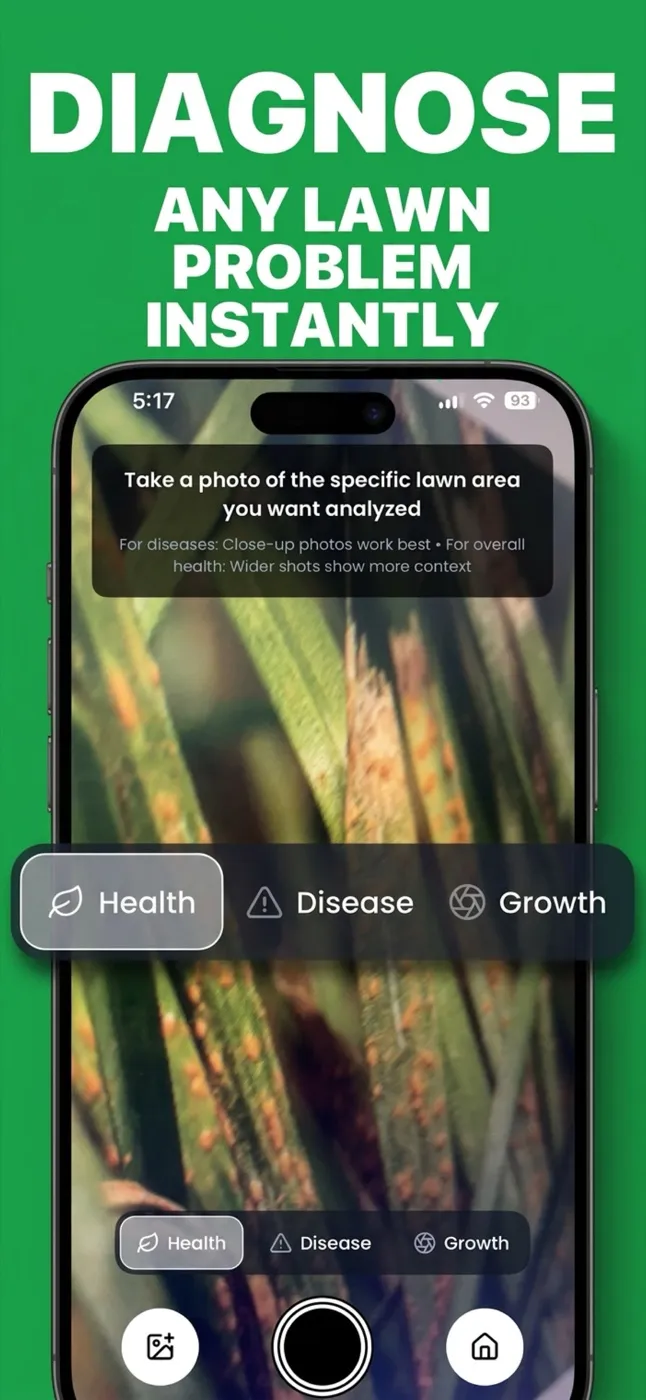
Grass X is our app, listed on the App Store as “Lawn Identifier: Grass X ID”. Its listing says it identifies grass from one photo and lists likely species, including Bermuda, tall fescue, fine fescue, zoysia, St. Augustine, Kentucky bluegrass, perennial ryegrass and centipede, with a confidence level, whether the grass is cool-season or warm-season, and how it handles shade, drought and foot traffic.
The same scan identifies weeds in turf, including crabgrass, dandelion, clover, nutsedge and moss, flags visible disease and pest damage, and, according to the Grass X website, gives a health score. The app then builds a care schedule around your grass type, frost zone and local conditions, and pauses tasks during dormancy or snow. It also tracks watering from observed rainfall and has an AI chat assistant that knows your grass type, location and lawn history.
Price as listed (November 2026): free to start, with a limited number of AI scans and chat questions each month. Premium is listed at $4.99 a week, $14.99 a month or $49.99 a year.
Best for: iPhone and iPad users who want to identify the grass and then get an ongoing plan for it in one app. It is not available on Android.
Grass Identifier AI: Lawn IQ: species ID with a care plan
Lawn IQ, from Format Partners LLC, says its AI analyzes blade shape, color and growth pattern to identify the species. Its listing names warm-season grasses (Bermuda, zoysia, St. Augustine, centipede, Bahia and buffalo) and cool-season grasses (Kentucky bluegrass, tall fescue, perennial ryegrass and fine fescue), plus common weeds such as crabgrass, clover, dandelion and nutsedge. Each identification comes with care recommendations covering mowing, watering, fertilizer timing, aeration, dethatching and overseeding, and a lawn health check helps spot issues such as discolored patches, fungal growth and pest damage.
Its listing says premium features include more identifications, the full species database, detailed lawn health diagnostics and seasonal care tracking, and that identifications are for educational and reference purposes. It requires iOS 18.5 or later.
Best for: iPhone users who want a species ID and a care plan for that grass, especially if their lawn is Bahia or buffalograss, which its listing names explicitly.
Grass Identifier (Kawaii): a detailed species profile
This app’s listing describes an AI breakdown for each photo: the common and scientific name, cool-season or warm-season, annual or perennial, a category (lawn, ornamental, pasture, native or weed), growth habit and blade characteristics, sun and water needs, mowing height and maintenance level, and USDA hardiness zones. A “My Log” section saves your identifications, and an “Explore” tab lets you browse identifications shared by other users. The listing notes that results are AI-generated and can be wrong.
Best for: curious homeowners who want a fact sheet for the grass they found, including grasses outside the lawn such as ornamental or pasture grasses. Its listing does not describe a care schedule or disease detection.
Grass identifier: Grasscan: care metrics and regional suggestions
Grasscan’s listing describes species identification from a photo, with recommendations for sunlight, fertilization, mowing height and water, plus disease and pest risks. You can save identifications to a “lawn collection,” and it offers region-specific guidance on which grasses suit your area. The listing says it is only for iPhone.
Best for: people planning a new lawn or overseeding who want to know which grasses fit their region as well as what is already growing.
Grass Identifier: AI Scan: grass, weeds and other plants
This app’s listing says it identifies grass types, weeds and plants, gives lawn care information and guidance on common lawn issues, and lets you save and track lawn health over time. It supports older devices (iOS 13 or later).
Best for: people who want one scanner for grass, weeds and other yard plants, or who have an older iPhone.
General plant identifiers: PictureThis and PlantNet
PictureThis, from Glority Global Group, is a broad plant identifier. Its App Store description does not mention lawn grasses or turf, but it does include weed identification with tips on controlling weeds in the garden. PlantNet is a free citizen science app developed by Cirad-France; its listing says it recognizes about 20,000 species, lists grasses among the plant groups it covers, and notes that photos of flowers, fruits and leaves give the most reliable results.
Best for: identifying garden plants, wildflowers and weeds in beds, or an unmowed grass with a seedhead. That last point is the catch for lawns: mowed turf has no flowers, which is why a lawn-specific grass identifier usually fits the job better.
Is there a free grass identifier app?
Yes, with limits. PlantNet is free with no in-app purchases listed, but it is a general plant identifier rather than a lawn tool. The lawn-specific apps above are free downloads with paid subscriptions, and the free tier varies: Grass X, for example, includes a limited number of AI scans each month. Lawn IQ lists additional identifications as a premium feature.
You can also identify grass for free without an app. Our grass identifier guide walks through the five features that separate common lawn grasses, with a quick key for eight species, and many county extension offices will help identify a sample.
How to get an accurate answer from any grass identification app
The photo matters more than the app. The UF/IFAS turfgrass identification guide uses the same close-up features as the Kentucky guide, so give the app a picture that shows them.
- Pick healthy grass. Stressed edges and brown patches look different from healthy turf.
- Shoot close and on a plain background. Pull a few shoots, lay them on white paper in daylight, and photograph the blade tip, the point where the blade meets the stem, and any runners.
- Add a wide shot. A photo from waist height shows texture, color and whether the grass forms clumps or a mat.
- Scan more than one spot. Many lawns are blends, especially cool-season lawns sown from seed mixes. Check sunny and shady areas.
- Check the result against a key. If an app says St. Augustine but the blade tips are pointed and the new leaf is rolled, retake the photo or try another spot.
A note on timing. In early November, warm-season lawns across much of the U.S. South are turning tan for winter, and dormant blades are harder for any tool to read. If your lawn is already dormant, photograph the runners and the base of the plant, or rescan when it greens up in spring. In the Southern Hemisphere, lawns are in active spring growth, which is a good time to identify them.
After you know your grass type
The species name is only useful if it changes what you do. It sets your mowing height, fertilizer timing and the diseases worth watching for. If your app identifies the grass but stops there, see our comparison of the best lawn care apps for homeowners for planning tools, or our guide to lawn disease identification apps if the grass looks sick rather than unfamiliar. Watering needs differ by species too; how much to water your lawn covers the basics.
Frequently asked questions
What is the best app to identify grass type?
For a lawn, choose a lawn-specific grass identifier over a general plant app. On iPhone, Grass X (our app) and Lawn IQ both pair the species ID with care recommendations; Grass X also builds a schedule that adjusts to your local climate.
Can PictureThis or PlantNet identify lawn grass?
Sometimes, especially when a seedhead is visible. Extension reviews report that grasses are harder for plant ID apps than broadleaf plants, and mowed turf has no flowers to photograph. Our guide to PictureThis grass identification explains when it works and how to photograph grass for it.
Is there a grass and weed identifier app?
Yes. As of November 2026, the App Store listings for Grass X, Lawn IQ and Grass Identifier: AI Scan all describe weed identification alongside grass ID. Our guide to lawn weed identifier apps covers weed-focused options in more detail. If you plan to treat a weed, follow the herbicide label and local regulations, and make sure the product is safe for your grass type.
How accurate are grass identifier apps?
Accuracy depends heavily on the photo and on how similar the candidate grasses are. Close-ups of the blade tip, the leaf base and the runners help most. Treat the answer as a strong suggestion and confirm it with a key such as our grass identifier guide or your county extension office.
Is there a grass identifier app for Android?
Grass X is available only on iPhone and iPad. The other lawn-specific apps in this guide are listed on the App Store; we did not verify Android versions of them. On Android, a general plant identifier or Google Lens is an option, but expect the same limits with mowed turf, and confirm the result with a grass key.