Best Lawn Disease Identification Apps: Free and Paid
Compare lawn disease identification apps for iPhone and Android: which are free, what each one diagnoses, and how to confirm a result before you treat.
By Ramachandran A V · · Editorial policy
A lawn disease identification app helps you name the problem behind a brown or spotted patch, either by analyzing a photo with AI or by walking you through a symptom key built by university and scientific-society turf experts. The best choice depends on what you need: a quick AI scan on your phone, a university-built reference you browse yourself, or an app that works on Android. The AI apps in this guide are free to download with paid upgrades, and the expert-built reference apps cost a small one-time fee.
Grass X is made by 1dot.ai, which publishes this blog. Details of the other apps below come from their official App Store, Google Play or university pages, checked as of October 2026. Prices and features change, so check the store listing before you download.
Lawn disease identification apps compared
| App | Made by | Platforms we verified | Price as listed (October 2026) | How it identifies disease |
|---|---|---|---|---|
| Grass X | 1dot.ai | iPhone and iPad | Free download, in-app purchases | AI analysis of a lawn photo |
| Grass Identifier AI: Lawn IQ | Format Partners LLC | iPhone and iPad | Free download, in-app purchases | AI grass ID from a photo, plus a “Lawn Health Check” |
| Lawn Care AI: Grass Identifier | Viksva | Android | Free download, in-app purchases | AI “Lawn Doctor” diagnosis from a photo |
| Purdue Turf Doctor | Purdue University | iPhone and iPad (Purdue’s Android link did not load in October 2026) | $1.99 on the App Store | Match symptoms and signs against reference photos |
| Turf MD | American Phytopathological Society | iPhone and iPad | $0.99 on the App Store | Peer-reviewed images and diagnostic keys |
Grass disease identification apps come in two kinds. AI photo apps (Grass X, Lawn IQ, Lawn Care AI) look at your picture and suggest a diagnosis. Expert reference apps (Purdue Turf Doctor, Turf MD) don’t analyze your photo; you compare what you see with their images and keys. AI apps are faster. Reference apps make you do more work, but you can see exactly why a disease fits or doesn’t.
What a lawn disease app can and can’t tell you
A brown patch is a symptom, not a diagnosis, and many of them aren’t diseases at all. The turf diagnostic lab at NC State Extension reports that in an average year about 40% of the turf samples it receives aren’t affected by a disease but by an abiotic stressor or injury. Abiotic means a non-living cause, such as drought, heat, compaction, fertilizer or herbicide injury, or mowing damage. The same lab cautions that accurate diagnosis can’t rely on pictures alone.
That shapes how to use any app:
- Good use: narrowing a mystery patch down to a few likely causes, learning the name of a disease so you can read about it, and spotting whether it looks like fungus, insects, drought or dog urine. Our guide to brown patches in your lawn walks through those causes.
- Not a substitute for: a lab diagnosis when the lawn is valuable, the damage is spreading fast, or you are about to buy a fungicide.
The apps in more detail
Grass X (iPhone)
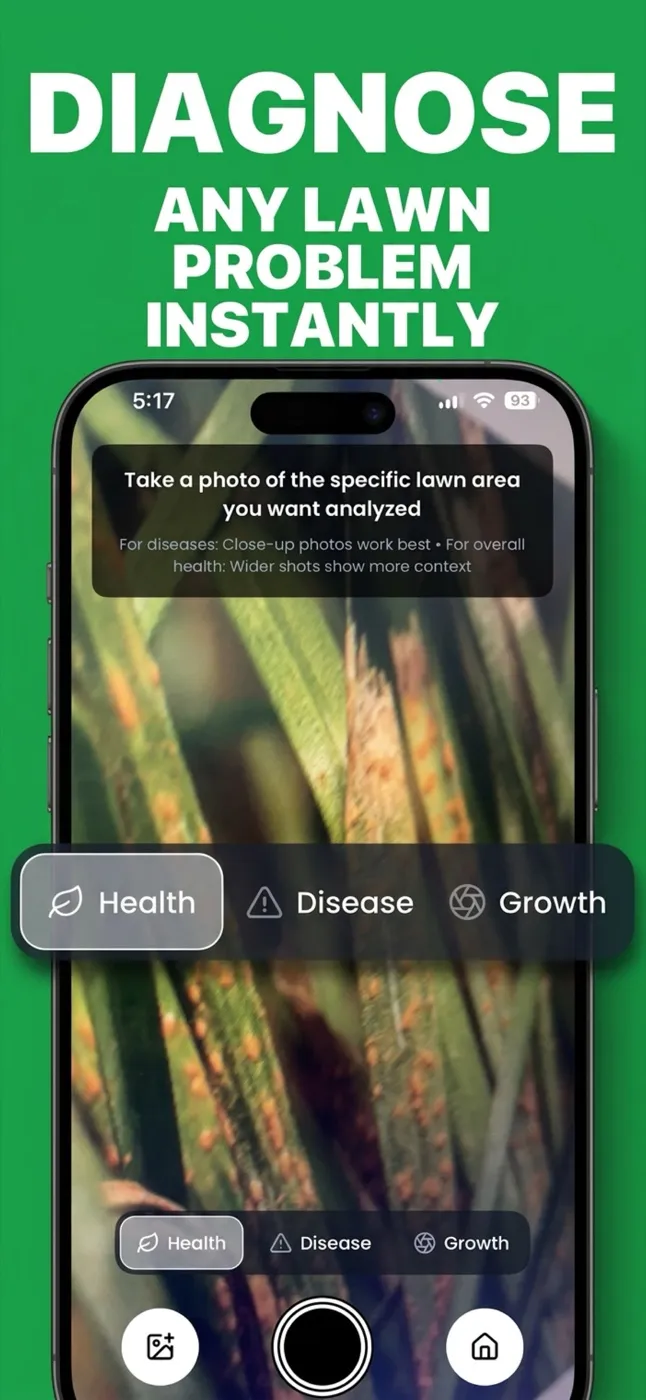
Grass X is our app. You photograph the problem area and it identifies your grass species, flags visible disease, weed and pest damage, and gives a health score with the name of the issue and a plain-English explanation. Its App Store listing names diseases including brown patch, dollar spot, rust, red thread, snow mold, powdery mildew and fairy rings, along with grub damage, chinch bugs, drought stress and nitrogen deficiency.
After the scan, the app turns the diagnosis into a care schedule for mowing, watering, fertilizing, weeds and pests, built around your grass type, local climate and observed rainfall, and it pauses tasks while the grass is dormant or under snow. If the problem turns out to be a weed rather than a disease, our guide to lawn weed identifier apps compares weed-focused options.
Best for: iPhone users who want a diagnosis and an ongoing lawn plan in one app. It is free to start, with a limited number of AI scans each month and a premium plan for more. It is not available on Android. If you want a planning app more than a diagnosis tool, see our comparison of the best lawn care apps for homeowners.
Grass Identifier AI: Lawn IQ (iPhone)
Lawn IQ, from Format Partners LLC, combines grass identification with a “Lawn Health Check” that its listing says helps identify common issues such as brown patches, fungus, pest damage, nutrient deficiency and disease symptoms, with action steps. The listing states that identifications are for educational and reference purposes and recommends a licensed professional for severe disease or pest problems.
Best for: iPhone users whose main goal is identifying their grass species, with a lawn health check and a care plan for that grass alongside it. Its listing also offers a lifetime purchase, which may suit people who would rather not subscribe.
Lawn Care AI: Grass Identifier (Android)
This Google Play app from Viksva describes a “Lawn Doctor” feature that diagnoses lawn disease, grub and chinch bug damage, nutrient deficiencies, drought stress, compaction and thatch, with a severity rating and treatment plan for each diagnosis. Its listing also covers grass identification, a weed scanner, a soil test reader and a fertilizer schedule.
Best for: Android users who want an AI photo diagnosis, since the other two AI apps here are listed only on the App Store.
Purdue Turf Doctor (iPhone)
Purdue Turf Doctor was developed by Purdue University experts to help homeowners and land managers diagnose turfgrass problems caused by diseases, insects, weeds, nuisance animals and abiotic stress. You filter by things like time of year, turf species, field pattern, symptoms and signs, then compare your lawn with high-resolution reference photos. Purdue notes it is most useful in the Midwestern and Eastern U.S.
As of October 2026 the App Store lists it at $1.99. Purdue’s page links an Android version, but the Google Play listing did not load when we checked, so confirm it is available before you count on it.
Best for: people who prefer a university-built key and want to understand why a diagnosis fits, especially because it also covers non-disease causes.
Turf MD (iPhone)
Turf MD, from the American Phytopathological Society, is a turfgrass disease reference with peer-reviewed images, diagnostic keys, decision support tools and recommendations. As of October 2026 the App Store lists it at $0.99.
Best for: readers who want a disease-only reference from a scientific society and are comfortable working through a key themselves.
Is there a free lawn disease identification app?
Yes, with limits. Each AI app above is a free download with in-app purchases; what you get without paying varies by app. Grass X, for example, is free to start with a set number of AI scans and chat questions each month.
The two expert reference apps are not free, but they are a small one-time purchase on the App Store rather than a subscription, as of October 2026.
Other options besides an app:
- Your county extension office. Many will help diagnose a lawn problem from a sample or photos, sometimes for a fee.
- A plant diagnostic lab. The National Plant Diagnostic Network has a directory of diagnostic labs across U.S. states and territories. Fees vary by lab.
Lawn disease identification apps for Android
Grass X and Lawn IQ are listed only on the App Store. On Android, the only app in this guide we could verify on Google Play as of October 2026 is Lawn Care AI: Grass Identifier, which offers AI disease diagnosis. Purdue’s website still links an Android version of Turf Doctor, but that Google Play listing did not load when we checked.
How to get an accurate result from any app
Whichever app you choose, the photo and the context you give it matter more than anything else.
- Take two kinds of photo. A wide shot from standing height shows the pattern (circles, rings, streaks, irregular blotches). Close-ups of individual blades show lesions, spots, threads or powdery growth.
- Photograph the edge of the patch. The border between healthy and damaged grass shows active symptoms; fully dead grass in the center tells you very little.
- Know your grass type. Many diseases favor particular grasses. If you are unsure, our grass identifier guide shows how to tell, and our guide to cool-season vs warm-season grass explains why it matters.
- Note the recent conditions. Humid nights, recent fertilizing, heavy watering or a hot dry spell all change the likely answer. Overwatering in particular encourages fungus; see how much to water your lawn.
- Check the result against the symptoms. If an app names a disease, read its typical symptoms and make sure they match what you see.
When to send a sample to a lab instead
Get a professional diagnosis when the damage is spreading quickly, the app’s answer doesn’t match what you see, or you are about to spend money on a fungicide. UF/IFAS Extension recommends digging a 4-by-4-inch square of turf, roots included, from the border between healthy and discolored grass, and sending it through your county extension office. Labs differ in forms, fees and shipping rules, so check with yours first.
If a disease is confirmed and treatment is needed, follow the fungicide label and your local regulations. Many lawn diseases improve with cultural changes alone, such as watering less often, adjusting fertilizer timing and improving airflow.
Frequently asked questions
What is the best lawn disease identification app?
It depends on your phone and how you like to work. On iPhone, Grass X (our app) pairs an AI photo diagnosis with a care plan that adjusts to your local weather; Lawn IQ also pairs AI scanning with care plans for your grass type. If you prefer to work through a university-built key, Purdue Turf Doctor covers disease and non-disease problems. On Android, Lawn Care AI: Grass Identifier offers AI diagnosis.
Is there a free app to identify lawn disease?
Grass X, Lawn IQ and Lawn Care AI are all free to download with in-app purchases. What the free tier includes varies: Grass X includes a limited number of AI scans each month, and Lawn IQ lists detailed lawn health diagnostics as a premium feature. The university and scientific-society reference apps cost a small one-time fee on the App Store as of October 2026.
Can an app tell the difference between fungus, grubs and drought?
AI apps try to, and a good photo helps, but problems like drought stress, grub damage and fungal disease can look alike from above. Pull back the turf to check for grubs, look closely at the blades for lesions, and compare the result with the symptoms in our brown patches guide. If an app suggests a fungus, our comparison of dollar spot vs brown patch helps you check the two most commonly confused ones.
Is there a lawn disease identification app for Android?
Yes. As of October 2026, Lawn Care AI: Grass Identifier on Google Play offers AI lawn disease diagnosis. Purdue’s website links an Android version of Turf Doctor, but the Google Play listing did not load when we checked. Grass X is currently iPhone-only.
Should I apply fungicide based on an app diagnosis?
Treat an app’s answer as a strong lead, not a final verdict. If the result is uncertain or the lawn is valuable, confirm with your county extension office or a diagnostic lab first. If you do treat, follow the product label and local regulations.