Lawn Diseases: How to Identify and Treat the Common Ones
A field guide to common lawn diseases: what brown patch, dollar spot, red thread, rust, snow mold and fairy ring look like, when they strike and what helps.
By Ramachandran A V · · Editorial policy
Most lawn diseases are caused by fungi, and you can narrow down which one you have from three clues: your grass type, the season and weather when the damage appeared, and what the spots and leaf blades look like up close. Brown patch and Pythium blight strike cool-season lawns in hot, humid summers. Dollar spot, red thread and rust show up in spring and fall, often on underfed or stressed grass. Snow mold appears as the snow melts, and large patch hits Zoysia and St. Augustine in spring and fall. In most home lawns, the fix is better watering, mowing and feeding rather than a fungicide.
First, check that you are dealing with a disease at all. Purdue Extension notes that in half or more of lawn diagnostic samples, a fungal disease is not the cause. Instead, the decline comes from things like compacted soil, drought or heat, chemical or salt injury, scalping and animal damage. Below are the common lawn diseases in North American lawns, how to tell them apart and what helps.
How to identify lawn disease (and rule out lookalikes)
Purdue Extension suggests three steps before you blame a fungus. We add a fourth.
- What grass is it? Many diseases only attack certain grasses. Purdue gives the example that dollar spot can be severe on Kentucky bluegrass, while tall fescue is not susceptible. If you are not sure what you are growing, our grass identifier guide walks through the features that matter.
- What has the weather been like? Fungi need moisture. Long dewy nights, frequent rain, saturated soil or evening watering all raise the risk. Heat narrows the list further: Purdue points to Pythium blight and brown patch when highs have been above 85°F.
- Is the damage spreading? Problems with a nonliving cause, such as drought or a fertilizer spill, tend to appear quickly and evenly and don’t spread from plant to plant. Disease usually starts in small spots and spreads in clusters or irregular patterns, with a gradient from dead to healthy grass. Diseases rarely form straight lines, unless a mower or running water has carried spores along a path.
- What do the blades show? Pull a few blades from the edge of a damaged area, where healthy and dying grass meet. Lesions with colored borders, orange powder, white flour-like coating, red threads or cobwebby growth on a dewy morning all point to a fungus. Uniform browning with no marks points elsewhere.
If the grass pulls up like loose carpet, look for grubs. If the brown areas sit in full sun along a driveway or slope, think drought first. Our guide to brown patches in your lawn compares fungal disease with grubs, chinch bugs, dog urine, drought and mower damage side by side.
Common lawn diseases at a glance
| Disease | Grasses most affected | When it appears | Signature sign |
|---|---|---|---|
| Brown patch | Tall fescue, perennial ryegrass | Summer, humid nights above 68°F | Circular brown patches; tan leaf lesions with a dark border |
| Dollar spot | Kentucky bluegrass, perennial ryegrass; can affect warm-season grasses | Late spring to early fall | Many small bleached spots; hourglass-shaped lesions |
| Pythium blight | Kentucky bluegrass, perennial ryegrass, tall fescue | Hot, humid summers (highs above 90°F, lows above 70°F) | Greasy, matted patches; gray cottony growth in the morning |
| Summer patch | Kentucky bluegrass, fine fescue | Late June to September | Straw-colored rings with green centers; dark, rotted roots |
| Red thread | Fescues, perennial ryegrass, Kentucky bluegrass | Cool, wet spring and fall | Pink or red threads at the leaf tips |
| Rust | Kentucky bluegrass, tall fescue, Zoysia, Bermuda | Late summer and fall (spring to summer in the South) | Orange powder that rubs off on shoes |
| Powdery mildew | Kentucky bluegrass in shade | Spring and early fall | White, flour-like coating on the leaves |
| Gray and pink snow mold | Most cool-season grasses | After snowmelt in late winter and spring | Matted, bleached circles, sometimes with pink edges |
| Large patch | Zoysia, St. Augustine, Bermuda | Spring and fall | Large orange-edged rings, often several feet wide |
| Fairy ring | All lawn grasses | Rings visible mostly in hot, dry weather; mushrooms after wet spells | Dark green or dead rings, often with mushrooms |
Sources: University of Maryland Extension, Purdue Extension and UGA Extension (linked in this guide). Timing shifts with your climate, so treat the months as a guide, not a rule.
Summer lawn diseases in cool-season grass
Summer heat already stresses tall fescue, ryegrass and Kentucky bluegrass, so this is when sudden damage is most likely.
Brown patch
Brown patch, caused by Rhizoctonia solani, is the classic midsummer lawn fungus on tall fescue and perennial ryegrass. University of Maryland Extension lists the conditions that favor it: daytime temperatures of 70 to 90°F, nights above 68°F, and humidity of 95% or more or more than 10 hours of leaf wetness. Look for circular, yellow-brown patches or general thinning, and for tan lesions with darker borders on the blades. The crown usually survives, so the grass often regrows once nights cool. Heavy summer nitrogen makes it worse.
Pythium blight
Pythium blight is less common but much faster. Purdue describes it as severe when highs are above 90°F and lows above 70°F with high humidity or rain. Patches start small, orange or dark gray, with a greasy, matted look and gray cottony growth in the morning, and they can spread quickly along drainage paths and mower tracks. Don’t mow or water active patches. It is not a true fungus and needs different fungicide chemistry, so get a lab diagnosis.
Summer patch and gray leaf spot
Summer patch mostly hits Kentucky bluegrass lawns that are two or more years old. Maryland describes straw-colored circular patches with bronze edges, sometimes with a green center that gives a doughnut look, and blackened, rotted roots when you pull a plant. Manage it by encouraging deep roots: avoid compaction and low mowing, and keep soil pH in check.
Gray leaf spot targets perennial ryegrass in late summer, and St. Augustine and other warm-season grasses in the South. The lesions are oval with gray centers and dark borders, and merged lesions can bend the leaf tip into a fishhook shape.
Spring and fall lawn diseases
These like mild temperatures and long dews. They are usually less destructive, and several signal a hungry or stressed lawn.
Dollar spot
Dollar spot makes many small, bleached, straw-colored spots, 1 to 3 inches across in short grass and 2 to 6 inches in taller grass, according to Maryland. Spots can merge into larger dead areas. Unlike brown patch, it is worse on lawns low in nitrogen, so a lawn that has gone a season without feeding is the typical victim. Our post on dollar spot vs brown patch explains how to tell the two apart.
Red thread
Look for thin pink or red threads growing from the blade tips; from a distance, patches look pinkish-tan. Purdue lists it from April to June and September to October on Kentucky bluegrass and the fescues, and notes that it attacks slow-growing turf. Adequate fertilizing usually reduces it a lot, and Purdue says cultural controls are usually enough without fungicide.
Rust
Rust shows up as yellow to orange flecks that become powdery pustules. Walk through a heavily infected lawn and your shoes turn orange. Purdue notes that, unlike most other diseases, rust is most severe in drought, and that it hits hardest when grass is growing slowly under stress such as drought, shade, low mowing or poor fertility. It rarely kills the lawn; fix the stress and collect clippings while it is active. UGA Extension also lists rust on Bermuda and Zoysia lawns in the South.
Powdery mildew and leaf spot
Powdery mildew looks like flour dusted on the blades, mainly on Kentucky bluegrass in cool, cloudy, shaded spots with poor airflow. Prune for air and switch to shade-tolerant grass. Leaf spot and melting-out cause purplish-brown to black spots and thinning; resistant cultivars help.
Winter lawn disease: gray and pink snow mold
Snow mold shows up as matted, bleached circles when the snow melts, and late fall is when to prevent it.
- Gray snow mold (Typhula blight) is worst where snow lies for a long time or melts slowly, though Maryland notes it doesn’t strictly need snow cover. Maryland describes patches from a few inches to a couple of feet across, with pale, matted blades that may carry white or gray growth and tiny dark sclerotia.
- Pink snow mold (Microdochium patch) does not need snow. Purdue explains that it can infect in any cool, wet weather below about 60°F. Under snow it leaves white or tan patches 2 to 12 inches across, which can show a pink or salmon edge while active; without snow, patches look reddish-brown and slightly greasy.
Both are usually cosmetic. Rake matted patches lightly in spring so they dry out and regrow. Prevention happens in fall: keep mowing until the grass stops growing, don’t let leaves sit on the lawn over winter, and don’t apply heavy nitrogen within six weeks of a killing frost, as Purdue advises. Our guide to how to winterize your lawn covers the full late-fall routine.
Warm-season lawn diseases
Bermuda, Zoysia, St. Augustine and centipede lawns have their own diseases, many striking at spring green-up or fall slowdown. If you are not sure which group your lawn belongs to, see cool-season vs warm-season grass.
- Large patch is the warm-season form of the Rhizoctonia fungus. UGA describes patches from less than 3 feet up to 25 feet across, with orange leaves at the edge, mostly on St. Augustine and Zoysia during spring and fall. Avoid nitrogen while it is active, raise the mowing height and improve drainage.
- Take-all root rot causes circular brown or bronze patches with dark brown roots in St. Augustine, Bermuda and centipede, mainly from summer to early fall. UGA links it to wet, high-pH, sandy or less fertile soils.
- Gray leaf spot on St. Augustine is favored by days in the 80s and nights above 65°F, according to UGA. Avoid heavy nitrogen in midsummer.
Fairy ring and slime mold: alarming but different
Fairy ring is caused by soil fungi that feed on buried organic matter, such as old stumps, roots or thick thatch. UGA’s fairy ring guide explains that the fungi don’t attack the grass directly. They change the soil, sometimes making it water-repellent. Rings come in three types: dead rings, dark green rings and rings of mushrooms or puffballs with little damage. Rings tend to return each year and expand outward. UGA states that no single strategy guarantees complete control. For home lawns, it suggests removing buried wood such as stumps and dead roots where you can, refilling with fresh soil and reseeding, and otherwise keeping up light fertilizing and regular mowing; chemical control is often unnecessary.
Slime mold covers grass blades with tiny gray, white or purple pinhead-sized bodies. UGA notes that the organisms are not parasitic. Mow, rake or hose them off and the grass underneath is fine.
How to treat lawn fungus
Extension services agree that home lawns respond best to fixing the conditions a fungus needs. Maryland goes further: it does not recommend fungicides for managing disease in home lawns, and notes that fungicides sold to homeowners are not very effective against brown patch, while professional products must go on before an outbreak and may need several follow-up applications.
What helps across most lawn diseases:
- Water deeply and less often, early in the morning. Daily short cycles and evening watering keep leaves wet for hours. Our guide on how much to water your lawn covers amounts and timing.
- Feed to match the disease. Underfed lawns invite dollar spot, red thread and rust. Lush, heavily fed cool-season lawns invite brown patch and Pythium blight.
- Mow high and keep the blade sharp. Maryland advises removing no more than a third of the blade at once and sharpening the mower blade after about 10 hours of use. Don’t mow wet grass, and mow diseased areas last so you don’t track spores around.
- Control thatch and compaction. Maryland suggests removing thatch once it is thicker than half an inch. Aeration helps roots and drainage, and Maryland recommends aerating diseased areas last so you don’t spread the infection.
- Pick resistant grass when you reseed. If the same disease returns every year, look for locally tested, disease-resistant cultivars.
Before you buy a fungicide
Confirm the disease first, ideally with your county extension office or state plant disease clinic, because fungicides are disease-specific and can’t revive grass that is already dead. If you go ahead, use a product labeled for that disease on your grass type and follow the label for rate, timing and safety. Check local regulations as well.
Identify lawn disease from a photo
A photo won’t replace a lab, but it can quickly narrow the list. In the Grass X iPhone app, a photo of the damaged area returns a health score, names the issue if it finds one and explains in plain English whether it looks more like disease, weeds, pests, thinning or drought stress. Close-ups of the blades at the edge of the damage work best for diseases.
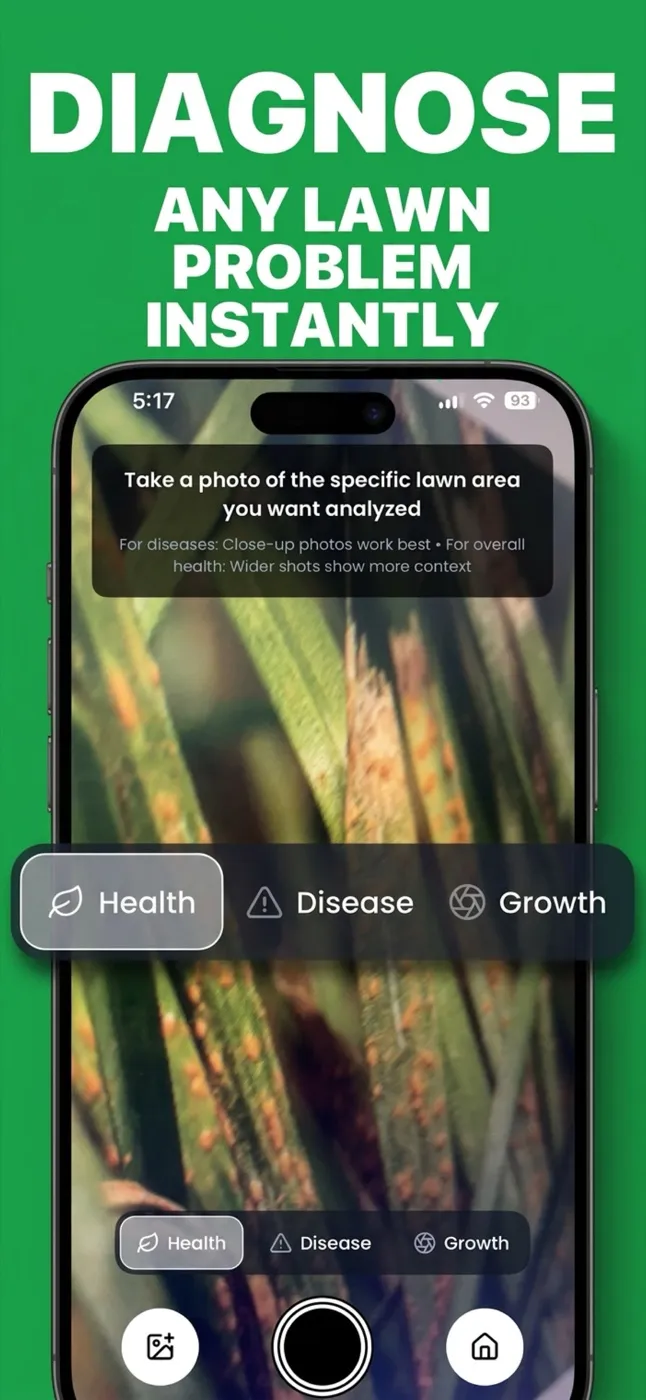
Grass X also builds a care schedule from your grass type and local observed rainfall, soil temperature and frost data, which supports the watering and feeding habits that prevent many of these diseases. For a comparison of other options, including free university tools, see our roundup of lawn disease identification apps.
Frequently asked questions
What is the most common lawn disease?
It depends on your grass and climate. In cool-season lawns, brown patch and dollar spot are among the most widespread, with brown patch most common on tall fescue in summer and dollar spot on Kentucky bluegrass and ryegrass. In warm-season lawns, large patch is a frequent spring and fall problem on Zoysia and St. Augustine.
Will grass grow back after lawn fungus?
Often, yes. Many leaf diseases, including brown patch, red thread, rust and snow mold, damage the blades but leave the crowns alive, so the grass recovers once the weather changes. Root diseases such as summer patch and take-all root rot, and severe Pythium blight, can kill grass outright, and those areas may need reseeding or new sod.
Can lawn fungus spread to other lawns?
Yes. Spores and fungal fragments move on mowers, shoes, water and wind. Clean the mower deck after cutting diseased grass, avoid walking on active patches when they are wet, and mow diseased areas last.
Should I put fungicide on brown spots in my lawn?
Not until you know the cause. Brown spots are often drought, grubs, dog urine or a dull mower, and fungicide won’t help any of those. If a disease is confirmed and keeps coming back, a labeled fungicide may be worth it, but university extension services generally recommend fixing watering, mowing and feeding first.