PictureThis Grass Identification: Can It Name Your Lawn?
Does PictureThis grass identification work on a mowed lawn? See what the app is built for, why turf is hard for plant ID apps and when a grass identifier fits.
By Ramachandran A V · · Editorial policy
PictureThis grass identification works best on grass that has been allowed to grow and flower, such as ornamental grasses, meadow grasses and grassy weeds that have gone to seed. On a regularly mowed lawn it is less dependable, because mowing removes the seedheads that general plant identifiers lean on. PictureThis is a strong all-round plant app, but its App Store listing does not mention lawns or turf. If your real question is “what lawn grass do I have, and how should I care for it?”, a lawn-specific grass identifier is usually the better tool.
Grass X is made by 1dot.ai, which publishes this blog. Details of PictureThis come from its official App Store listing, checked as of November 2026. We have not run our own accuracy tests on either app, so this guide sticks to what the listings and extension specialists say.
What PictureThis says it does (as of November 2026)
PictureThis - Plant Identifier is made by Glority Global Group Ltd. and is listed for iPhone, iPad and Apple Vision. Its listing describes:
- Plant identification from a photo, covering “over 400,000 plant species.” The developer also says the app identifies “millions of plants daily with over 98% accuracy.” That is the developer’s own figure, not an independent test, and it is not specific to grasses.
- Plant disease diagnosis. You photograph a sick plant and get a diagnosis with treatment advice. The listing’s example is a houseplant with brown spots.
- Weed identification for “your garden,” with tips on controlling or removing weeds.
- Toxic plant warnings for pets and children, care reminders, a water tracker, a light meter and a “My Garden” collection.
- Expert chat around the clock for plant questions.
The download is free. The listing shows in-app purchases for PictureThis Pro, which it describes as “unlimited plant IDs, care tips, and diagnoses,” at $3.99, $7.99 and $39.99, plus a Family Plan at $49.99, and it mentions a free trial. The listing does not say which price matches which billing period, so check inside the app before you subscribe.
What the listing does not mention is just as useful to know. It says nothing about lawn grasses, turf, mowing height or lawn care schedules. That doesn’t mean PictureThis can’t name a grass. It means the app is designed for the whole plant world, not for the lawn specifically.
Why grasses are hard for plant identifier apps
Most plant identifiers learn from flowers, fruit and leaf shape. Lawn grass gives them very little of that to work with.
Kansas State University’s Turfgrass Identification guide puts it plainly: “The seedhead, the main identifying feature, is not present in mowed turf.” Turf specialists identify lawn grasses from small vegetative features instead: whether the new leaf is folded or rolled in the bud, the ligule where the blade meets the stem, the auricles, hairs on the blade or sheath, and whether the plant forms clumps or spreads by stolons or rhizomes.
Independent testing points the same way. A 2024 Montana State University Extension post on plant ID apps cites Michigan State University testing in which PictureThis was the most accurate app in 2023, by that study’s criteria. The same post says apps often got the genus right but the species wrong, did better on mature plants than on seedlings, and that “grasses or grass-like plants may be more difficult for these apps to accurately identify compared with broadleaf plants.”
So PictureThis can be one of the better general identifiers and still struggle with a mowed lawn. That isn’t a flaw unique to it. A close-cropped tuft of turf is simply one of the hardest things to identify from a photo.
Why the species matters for a lawn
Getting the genus right is often enough in a flower bed. In a lawn, it can leave you with the wrong care plan. A few examples:
- Fescues. Tall fescue and fine fescues are both Festuca, but they are mowed at different heights and handle shade and traffic differently.
- Bluegrasses. Kentucky bluegrass (Poa pratensis) is a desirable lawn grass. Annual bluegrass (Poa annua) is usually treated as a weed in home lawns.
- Cool-season vs warm-season. Mixing these up changes when you fertilize, overseed and expect dormancy. Our guide to cool-season vs warm-season grass explains the split.
Plant identifier vs grass identifier: which fits your question?
The real choice is between two kinds of tool. Here is how they differ for lawn questions, based on what the listings describe.
| Question you’re asking | General plant identifier (PictureThis) | Lawn-specific grass identifier |
|---|---|---|
| “What is this tall grass with a seedhead?” | Good fit. Seedheads are what plant apps read best | Works too, but this is not what they are built around |
| “What ornamental grass is this in my border?” | Good fit. Its database covers garden plants | Often outside their focus |
| “What lawn grass do I have?” (mowed turf) | Possible, but grasses are a known weak spot | Built for this, usually naming lawn species and season type |
| “Is it cool-season or warm-season?” | Not described in the listing | Usually part of the result |
| “What weed is in my lawn?” | Helpful for flowering broadleaf weeds | Most list common lawn weeds such as crabgrass and nutsedge |
| “Why is my lawn turning brown?” | Disease diagnosis is aimed at plants in general | Several scan turf for disease, pest and drought damage |
| “What should I do this month?” | Care reminders for individual plants | Some build a lawn schedule around your grass and climate |
If you garden as well as mow, PictureThis earns its place for the beds, borders and houseplants. For the lawn itself, a turf-focused app answers more of the follow-up questions.
When PictureThis is a good choice for grass
PictureThis is worth trying first in these situations:
- The grass has been allowed to flower. Field margins, an unmowed corner, a meadow patch or a neglected strip along a fence often carry seedheads. That gives a plant identifier the feature it works with best.
- It’s an ornamental grass. Fountain grass, maiden grass, blue fescue and other border grasses are garden plants, and that is where a general plant app is strongest.
- It’s a grassy weed gone to seed. A clump of something wiry that shot up above the lawn may have a seedhead you can photograph. Check the answer against an extension weed guide before you treat it.
- You want one app for the whole garden. If you mostly care about shrubs, vegetables and houseplants and only occasionally wonder about the grass, one subscription may be enough.
When a lawn-specific grass identifier fits better
A turf-focused app is usually the better tool when:
- The lawn is mowed and there are no seedheads. That is most lawns, most of the year.
- You need the season type and care details. A species name is only the start. It doesn’t tell you how short to mow, when to feed or which diseases to expect.
- The lawn has a problem. Brown spots, thinning or a weed invasion need a turf diagnosis. Our guide to brown patches in your lawn shows why the same symptom can have six different causes.
- You want a plan, not just a name. Turning “this is tall fescue” into a monthly to-do list is where lawn apps differ most from plant apps.
Our own app, Grass X, is one example of a PictureThis alternative for lawns. Its App Store listing says it names common lawn grasses from one photo, tells you whether they are cool-season or warm-season, and then builds a mowing, watering and fertilizing schedule for that grass and your local climate. It also scans for lawn disease, weeds and pests. It is an iPhone and iPad app and is not available on Android.
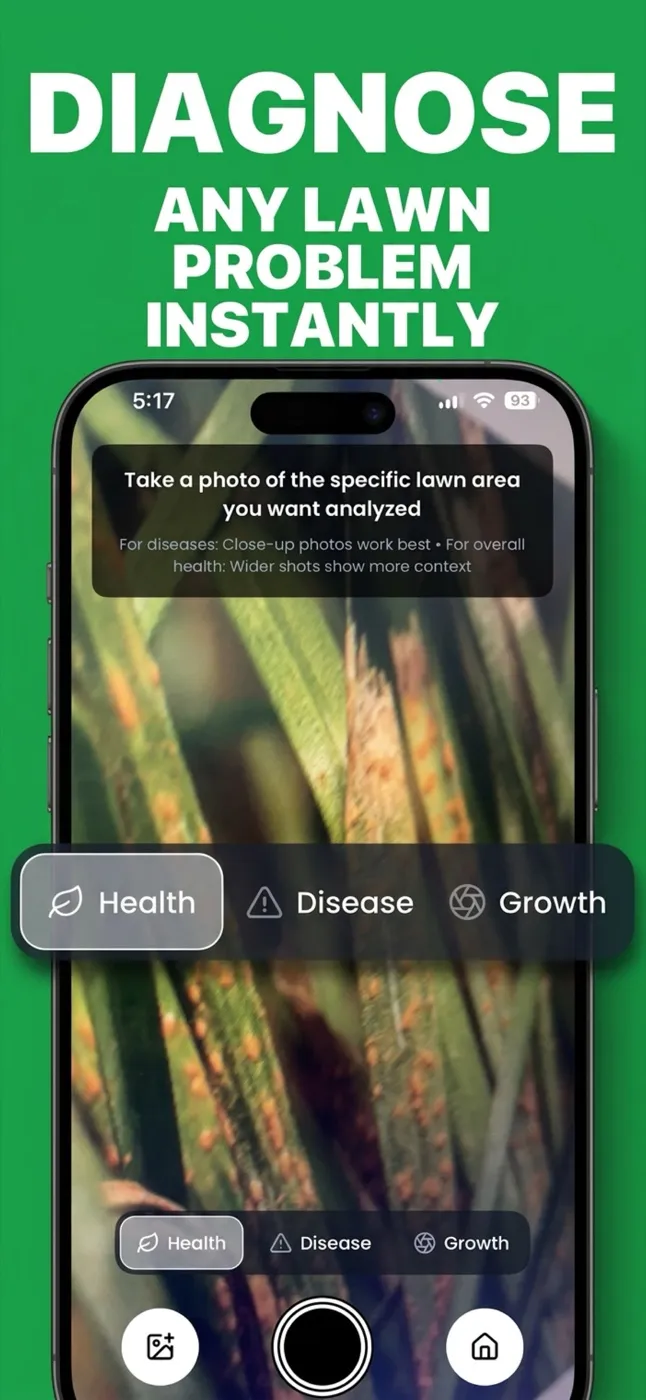
Grass X isn’t the only option. Our comparison of the best grass identifier apps covers seven iPhone apps side by side, including other lawn-specific identifiers and PlantNet, a free general plant identifier. If you already have the Google app, our guide to whether Google Lens can identify grass covers that free option.
How to get a better grass ID from PictureThis
If you want to try PictureThis on your lawn, the photo makes most of the difference. These steps follow the features turf specialists use:
- Look for a seedhead first. Check the lawn edges, around trees and along fences, where the mower misses. A flowering stem is the most useful thing you can photograph.
- Pull a few shoots. Lay them on white paper in daylight so the app sees the grass, not the soil and the neighboring plants.
- Photograph the collar. Get close to the point where the blade meets the stem. This is where the ligule and auricles are, which the Kansas State guide relies on.
- Show the base. A shot of the crown or runners shows whether the grass forms clumps or spreads by stolons or rhizomes.
- Read the scientific name. Check that the answer is a grass sold for lawns in your area, not just the right genus. Montana State Extension suggests searching the Latin name and checking that the plant is known to occur in your state.
- Confirm before you act. Compare the result with a key such as our grass identifier guide, or take a sample to your county extension office.
A note on timing. Mid-November is a poor month to test any app on a lawn. Warm-season lawns in the U.S. South are dormant and tan, and cool-season lawns have stopped flowering, so a plant identifier has even less to go on than usual. If two or three scans give different answers, keep a dried sample to compare later, or wait for spring growth. Readers in the Southern Hemisphere are in that spring window now.
Can PictureThis identify weeds and diseases in a lawn?
Its listing describes both weed identification and plant disease diagnosis, framed around garden plants rather than turf. Flowering broadleaf weeds such as dandelion are the easiest case for any plant app. Grassy weeds and sedges in a mown lawn are the hardest, for the same reasons as lawn grass. Our guide to lawn weed identifier apps covers weed-focused tools and a free extension weed key.
Turf diseases are a separate problem. Many show up as patterns across the lawn, such as rings, patches or spots on individual blades, rather than as one sick plant. For that, see our roundup of lawn disease identification apps. Whichever app you use, confirm the diagnosis before you buy a product, and follow the product label and local regulations if you treat.
Frequently asked questions
Can PictureThis identify grass?
It can try. Its listing covers over 400,000 plant species, and grasses with visible seedheads give it the most to work with. It doesn’t mention lawns or turf, and extension reviews report that grasses are harder for plant ID apps than broadleaf plants. Treat its answer for mowed lawn grass as a starting point and confirm it.
Is PictureThis free?
PictureThis is free to download. As of November 2026, its App Store listing shows PictureThis Pro in-app purchases at $3.99, $7.99 and $39.99, a Family Plan at $49.99, and a free trial. Check inside the app to see what the free version includes and what each plan costs per period.
What is a good PictureThis alternative for identifying lawn grass?
A lawn-specific grass identifier, because it is built for mowed turf and usually adds the season type and care advice. Grass X (our app) is one option on iPhone. Our best grass identifier apps guide compares several others.
Is PictureThis accurate?
The developer says it identifies plants “with over 98% accuracy,” a figure that is not specific to grasses. Montana State Extension’s summary of Michigan State University testing ranked PictureThis first among the apps tested in 2023. The same summary notes that apps often got only the genus right, and that grasses were harder than broadleaf plants.
What’s the difference between a plant identifier and a grass identifier?
A plant identifier covers hundreds of thousands of species and works best with flowers, fruit and distinctive leaves. A grass identifier focuses on lawn species, uses close-ups of blades and growth habit, and usually tells you whether the grass is cool-season or warm-season and how to care for it.